Effective Time Management Exercises for Improved Productivity
Published: July 31, 2026
Productivity is not something that comes with being busy. There is a common misconception that increasing the number of hours will enhance productivity. But that’s not true! Productivity has nothing to do with increasing the working hours.
According to a Gallup study, employee engagement significantly impacts business productivity.
Productivity is undoubtedly crucial for the success of any business. There are different strategies that businesses use to improve the productivity of their employees, with time management strategies at the top of the list, especially when organizations face challenges such as missed deadlines.
"The bad news is time flies. The good news is you're the pilot." -- Michael Altshuler
It’s not rocket science to increase productivity at work. If employees work smartly by taking care of the time they spend at work, then it becomes easy for them to boost their productivity at work. This can be achieved through time management exercises, time management techniques, and time management tools that help employees manage time effectively.
In this blog post, we explore how, some key time management training activities can help to improve employee productivity at work
1 – Training To Avoid Poor Time Management

There is only a limited number of working hours a day, and a handful of interruptions can easily rob your time and make you unproductive. Time-wasting habits like constant phone notifications or unplanned, unexpected visitors can significantly impact productivity.
Do you know that it takes more than 20 minutes for a person to get back to the task after a distraction?
Well, that’s too much time!
A study done by UC Irvine confirms that it takes more than 20 minutes to deal with a single distraction.
Unnecessary interruptions can increase the time that is not productive and reduce the ability to focus. Encourage employees to avoid time-wasting activities during daily routines to enhance productivity. productivity level of employees. One of the biggest factors that increases interruptions is the use of social media. We can’t simply ask them to avoid phones, but encourage them to turn their mobile off for a certain time so that they can concentrate better on work. Proper stress management also comes into play when handling these interruptions effectively.
2 – Track Time with Project Management Techniques
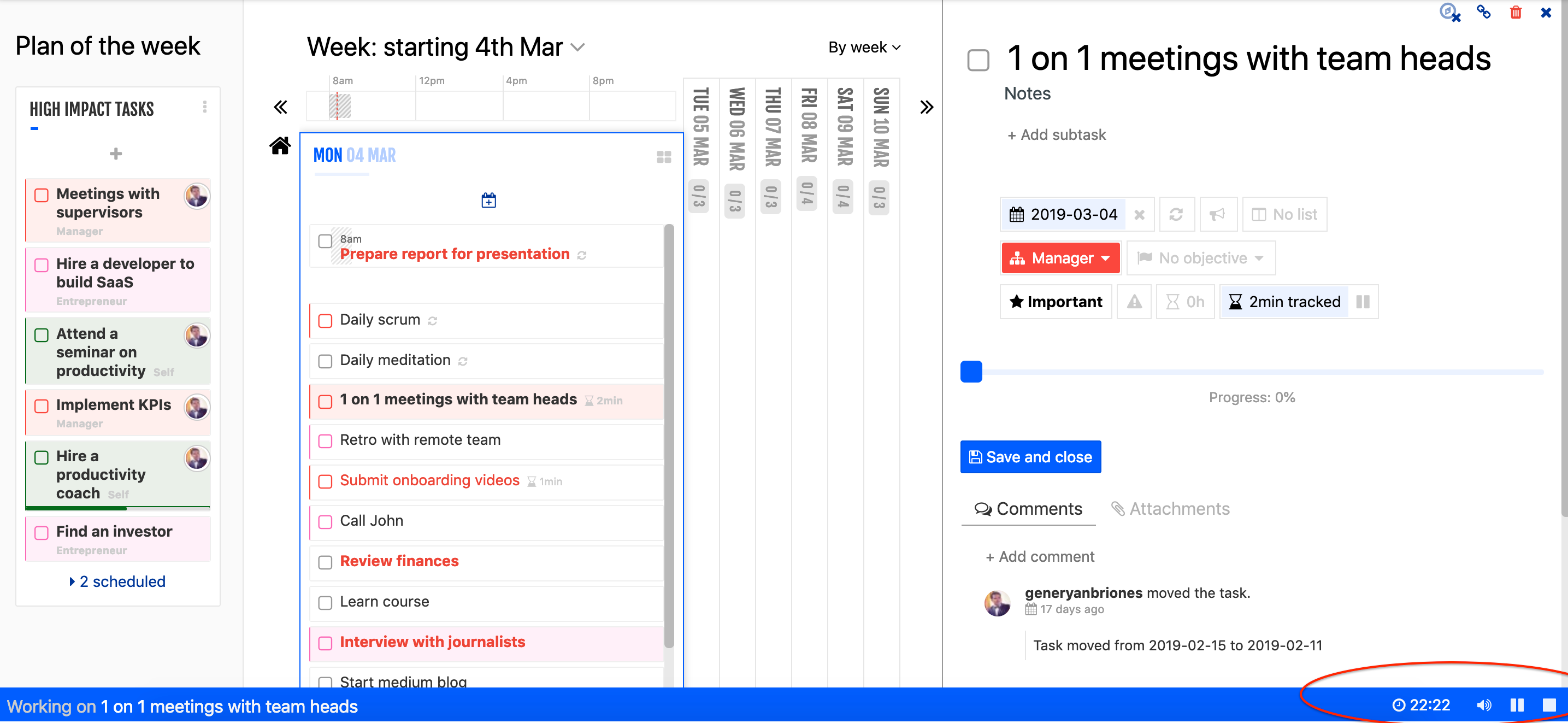
Whether you are a manager or an executive, knowing where your time goes matters a lot for productivity. For that, the best way is to track your time using time tracking software.
Time tracking is one of thebest activities of time management at work. It helps to capture everything you do while working. Knowing everything is being captured continuously helps employees to show maximum productivity. Time tracking shows the exact amount of time you get distracted and which things slow you down. Apart from collecting time data, these apps also present helpful reports that can be used to identify the trouble areas. This is especially useful for scheduling time and planning to-do lists.
Using time tracking tools, employees can identify time-wasters and poor time-management tendencies, while managers can allocate resources better. Tracking time ensures team members can effectively manage their tasks and complete them without missing meeting deadlines. Additionally, incorporating team-building activities can strengthen collaboration and improve overall workflow, further enhancing productivity.
3 - Set Prioritization Among Tasks
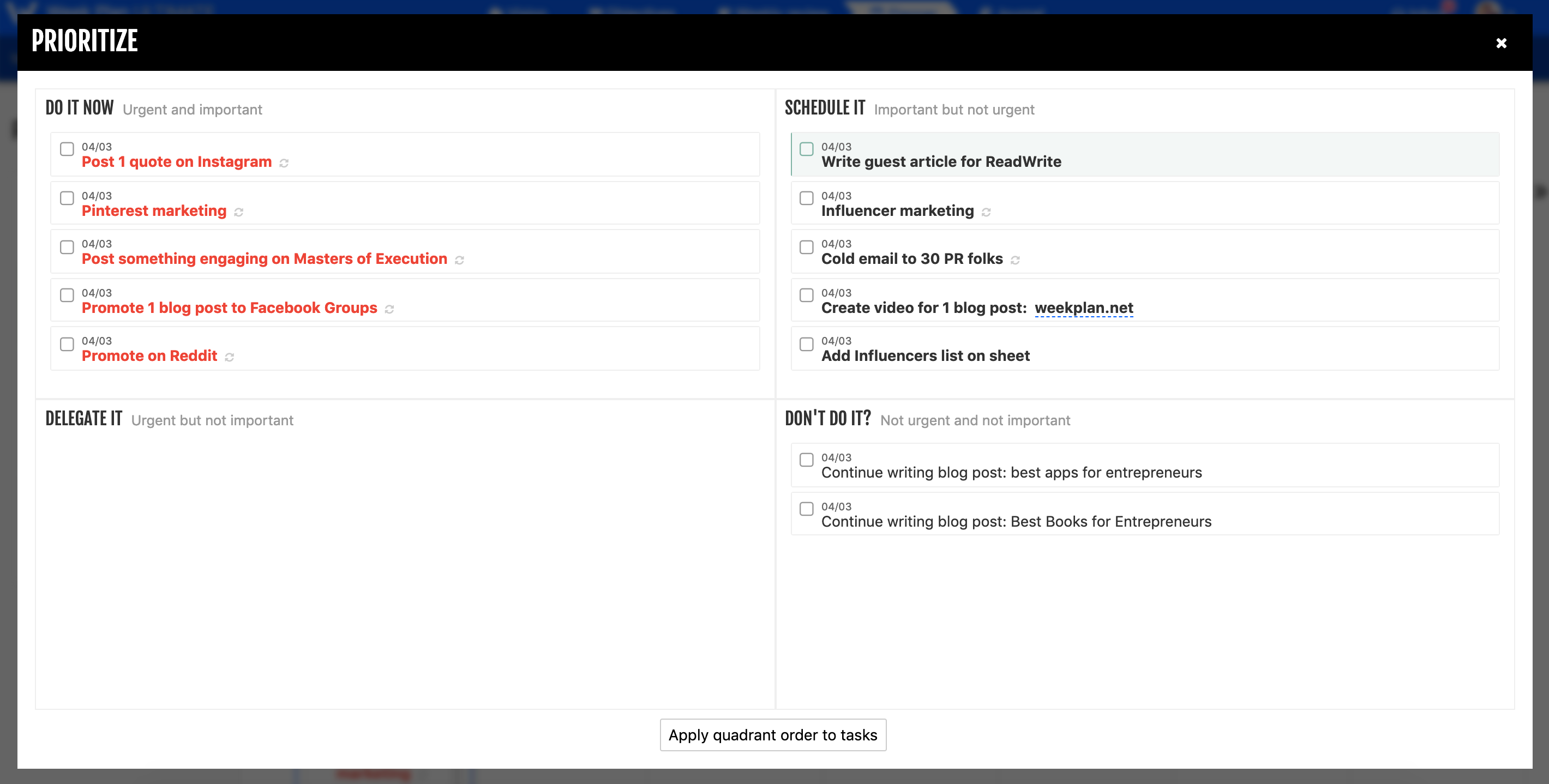
Many businesses are confused when prioritizing tasks, especially when it comes to urgent and important tasks or urgent tasks. Using a prioritization process can help employees identify high-priority tasks and routine tasks that need to be addressed first.
If you have more than one important task, then you should list them in the form of a sequence and tick them off one by one once finished. It enables you to tackle your important tasks first so that you can move towards other routine jobs.
Task prioritization not only increases productivity (https://weekplan.net/Personal-Growth-Tips-to-Massively-Increase-Productivity/) but also keeps employees motivated. When they see the positive outcomes, their motivation towards handling more tasks will increase, which will automatically enhance their productivity.
4 - Finish Unpleasant Tasks First with Time Management Activities

Employees often postpone tasks they dislike. By addressing these first, they can handle challenging tasks, reduce stress, and improve overall well-being. This also strengthens time management skills and helps employees accomplish tasks efficiently.
Instead, if employees allocate time in the morning to planning how to handle all the unpleasant tasks of the day, they will not only complete those tasks with ease but also become more stress-free and confident in handling other jobs, allocating as many blocks of focused time as needed to finish each task efficiently.
5 - Identify Personal Productivity Rhythm for Big Picture Planning

Employees should monitor their peak hours of productivity using time management exercises and adjust their daily routines accordingly. This allows for dedicated time on challenging tasks, short breaks, and more free time to boost productivity.
Visual exercises, like time-squared ribbon cutting, demonstrate how limited work hours are compared to life’s total time. This activity emphasizes time constraints, resource allocation, and the importance of effective time management games to manage tasks.
6 - Make Employees Realize the Importance of Time Using Ribbon Cutting and Free Time

Ask all your employees to gather at a single place, then show them a ribbon of 100 centimeters. Now, first cut that ribbon till its length equals the average lifespan. After that, trim away the average age of the small groups so that you can show them the time remaining from the entire lifespan. During this exercise, have the participants fill out a quick reflection sheet to note what the remaining time means for their priorities and tasks.
Continue the ribbon-cutting process, excluding all activities unrelated to work, such as spending time with family and time spent sleeping, etc. This exercise also helps participants understand the value of each minute.
7 - Provide them Buffer-time Between Tasks
Do you know that the human brain can only focus for 90 to 120 minutes at a time?
The human brain has a normal tendency to work continuously for almost 120 minutes. After that, a brief break is necessary to maintain the same level of efficiency in delivering the work. During focused sessions, try simple exercises like writing with your non-dominant hand to boost brain activity and maintain alertness.
Employees can focus better with dedicated time and short breaks between tasks. This reduces stress, minimizes non-productive time, and ensures time management techniques are applied to stay focused on urgent and important tasks.
8 - Provide Them With Time Management Exercises

Time management training activities and management training sessions help employees develop time management skills, decision-making, teamwork skills, and students learn how to delegate tasks effectively. This ensures professional success and allows employees to complete tasks efficiently.
Small groups training activities and management sessions help employees develop time management skills, decision-making, teamwork skills, and students learn how to delegate tasks effectively. This ensures professional success and allows employees to complete tasks efficiently.
Providing comprehensive training not only enhances the image of the company in the eyes of employees but also boosts their morale and job satisfaction as well.
If your employees have a certain weakness that can hinder their performance, then training is a good starting point to address their deficiencies. Comprehensive training also makes them feel more confident to make decisions on the fly, ensuring they make the most of all the clocks during their workday.
9 - Discourage Multitasking At Work

Multitasking reduces focus and increases time wasters. Focusing on one task at a time, time blocking techniques, and hourly blocks of dedicated work time ensure employees effectively manage projects while reducing errors.
Attempting to perform multiple tasks simultaneously can increase the body's stress level and affect the well being, leading to negative consequences such as reduced performance and employee absenteeism.
When an employee tries to juggle two tasks at a time, the chances are that they end up underperforming both tasks because multitasking can increase mistakes instead of getting them done instantly. That’s why it’s better to concentrate on one task at a time so that it can be done with perfection.
10 – Communicate With Employees Effectively

The business that invests time in delivering clear communication will rapidly build trust among employees; on the other hand, a business that lacks open communication between managers and employees will face issues related to productivity.
Good communication with employees not only helps to eliminate misunderstandings, but also promotes a healthy working environment as well because “It’s not what you say, but how you say it.”
It is very important for managers to have effective communication among employees so that there will be no communication gap, because it restricts an employee’s ability to understand things. Using this approach, employee productivity increases because they feel directly associated with the organization’s mission and goals.
11 - Prioritize Tasks To Set Realistic Goals for Employees

Employees will be more productive if they have an achievable goal to aim for. Setting achievable goals using time management techniques ensures employees understand time wisely, setting priorities can be priority tasks, and avoiding time-wasting habits. Managers can review performance during performance review sessions to identify areas for improvement.
When employees don’t meet their goals, they either give up or stress themselves out. That’s why it is better to set reasonable goals according to the capabilities of employees.
Setting meaningful goals for your business and employees can drive better performance and higher productivity. It can also encourage employees to collaborate and work as a team.
12 - Listen to Them

Listening to your employees is also important to improve their productivity. It helps to let the organization know what’s holding their employees back so that they can tell them where they need to improve.
Employees who feel listened to are more attached to the employer as compared to other employees. They show more motivation and engagement in doing their best for the company.
Listening promotes a positive tone and allows managers to identify time-wasting activities and poor time management behaviors, helping employees accomplish tasks efficiently while eliminating stress.
13 - Promote a Work-Life Balance And Manage Time

Creating a balance between work and personal life will not only improve employees' well-being but also lead them towards a productive lifestyle.
Sometimes, overworking can be detrimental to employee productivity. If your employees spend too much time in the office, then it can interrupt their work-life balance. That’s why it is necessary to ensure that employees don’t spend a lot of time effectively in the office, because instead of getting more done, they will end up wasting time.
If your employee is sacrificing a lot of time for the sake of work, then there is a strong chance that they will experience health-related issues soon. That’s why the best is to ensure the right balance between work and life so that they can easily maintain their productivity.
14 - Schedule Quiet Hours for Employees

Collaboration in the team regarding work is quite common among many organizations, but it’s not effective every time because sometimes what is needed is some private space to think about complex tasks.
According to a survey, 58% of high-performing employees said that they require more private time to resolve complex problems successfully.
So, now you realize the significance of quiet hours for employees and how it helps them think in a more better way towards complex projects. You can also get the benefit from this by offering quiet hours to your employees.
15 - Avoid Unnecessary Meetings

Meetings can be extremely effective for sharing ideas and finding solutions to problems together, but they can also be a huge drain of time if not utilized properly.
Don’t ask the employees to attend the meeting who have nothing to do with it because it ends up wasting their time, which they can easily utilize on their task sheet.
If the meeting has no agenda, then there is no need to arrange a meeting for employees because it will only waste their time. Therefore, ensure that you schedule a meeting that adds value to employees, where they can discuss issues and find appropriate solutions, following practical strategies to make the session effective.
16 - Activities of Yesterday

Ask your employees to write three to five topics that they like to discuss in the next performance evaluation. After they write the topics, ask them to write eight to ten activities they worked on yesterday.
Once they are done with that, ask them to mention the link between topics and activities. It will help to allocate time your employees are spending on small groups activities that contribute to the topics, and which activities don’t add any value to the mentioned topics.
Summing It Up
A workplace that is full of stress can never produce productive employees because employees can’t produce their best work in such conditions. The time management activities discussed in this article will not only help to improve employee productivity but also help them manage their work before time. So, start implementing these activities to improve time usage from today and enjoy reaping amazing benefits.