Habit 4: Think Win-Win — Covey's 6 Paradigms of Human Interaction
Published: February 28, 2019
This article is part of our complete guide to The 7 Habits of Highly Effective People — summaries of every habit and how to practice them weekly.
Summary of Habit 4 of 7 Habits
Think Win-Win is a frame of mind, not a negotiating tactic. Covey's starting point is that most of us were trained to read every interaction as a contest: for me to win, you have to lose. He calls that Win-Lose, and it is only one of six paradigms he lays out — alongside Lose-Win, Lose-Lose, Win, Win-Win, and Win-Win or No Deal. Each one works somewhere. Only Win-Win holds up in a relationship you intend to keep. To see how this fits the wider framework, read the 7 Habits of Highly Effective People book summary.
Win-Lose is seductive because it looks like winning. You get the better end of the deal and walk away ahead. What you don't see on the invoice is the cost: the other side remembers, and the next negotiation starts from a worse place. Covey's argument is practical, not moral — Win-Lose spends the relationship to buy the transaction.
Underneath Win-Win sits what Covey calls the Abundance Mentality: the belief that there is enough out there for everybody. Its opposite, the Scarcity Mentality, treats life as a fixed pie, so someone else's slice is subtracted from yours. That's what makes people struggle to be genuinely glad for another's success — even someone they love.
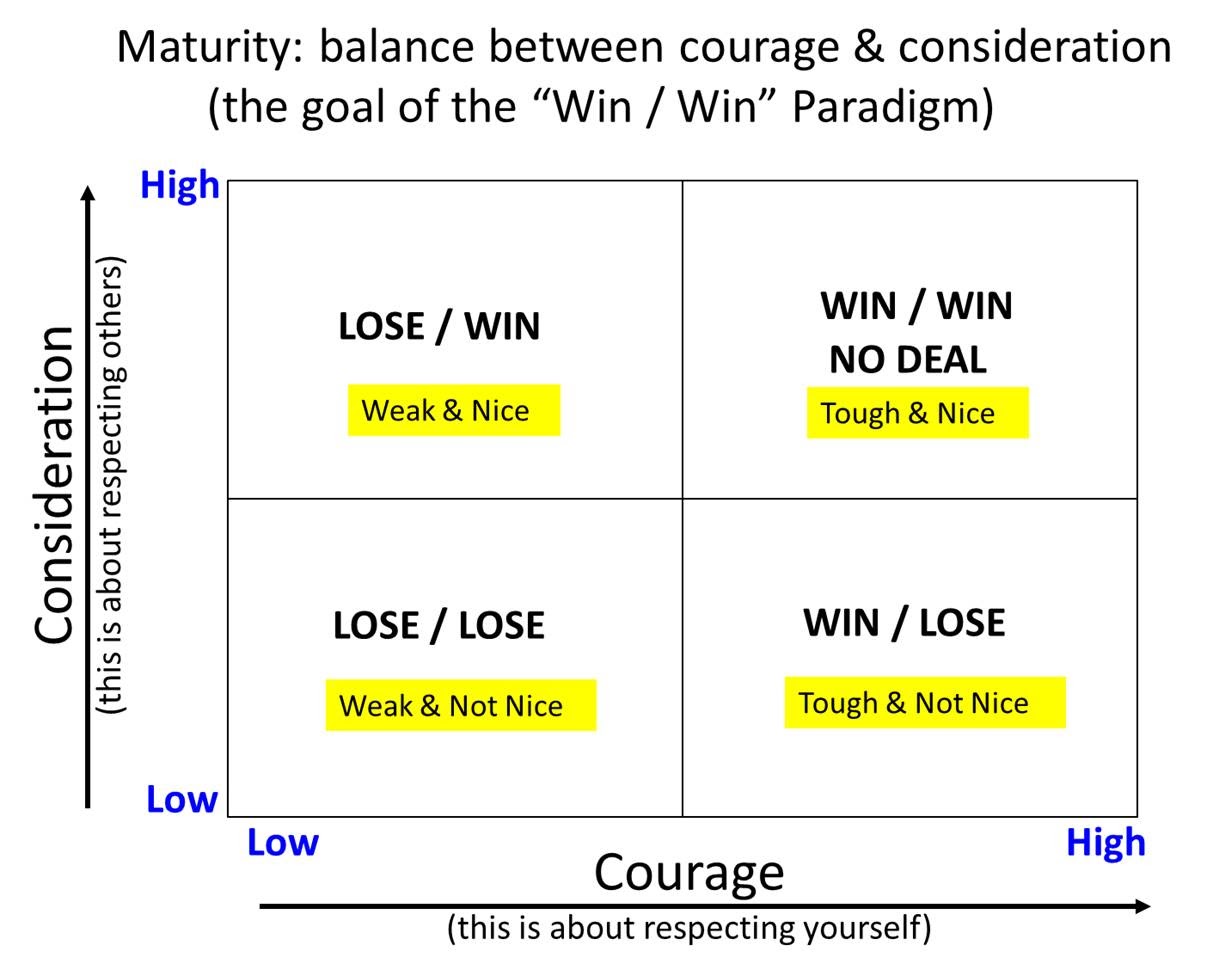
Getting there takes two things at once, and most of us are good at one. Courage is saying what you actually want. Consideration is caring what the other person wants. High courage with low consideration produces Win-Lose. High consideration with low courage produces Lose-Win — the "nice" one who quietly gives in and quietly resents it. Covey calls the balance of the two maturity, and it rests on character: integrity, maturity, and that Abundance Mentality.
Win-Win runs on knowing what the other side actually needs, which is the whole of Habit 5: Seek First to Understand, Then to Be Understood — you cannot find a deal that works for someone you have not bothered to hear. And once both sides are genuinely in, you get the conditions for Habit 6: Synergize, where the answer you reach together beats either of the ones you brought.
The escape hatch matters as much as the ideal: Win-Win or No Deal. If you cannot find something that genuinely works for both of you, you agree to disagree — agreeably. No forced compromise nobody believes in. Having No Deal in your pocket is what makes Win-Win honest rather than a pose, because you are no longer negotiating from a position where you must say yes.
Where Habit 4 Sits Among the Others

Habit 4 is the first of the public victories, and Covey is deliberate about the order: it does not work until the private ones are in place.
It rests on Habit 1: Be Proactive, because until you accept that your response is your own choice, you cannot change how you show up in a negotiation — you just react to whoever is across the table. It needs Habit 2: Begin with the End in Mind, because a deal that is good for both of you but takes you somewhere you never wanted to go is not a win. And it needs Habit 3: Put First Things First, because the discipline to hold your priorities is what gives you the standing to say No Deal.
That is why Covey calls Win-Win a character-based code rather than a technique. You cannot fake an Abundance Mentality across a table from someone; it shows.
Why is Habit 4 so Important?
Habit 4 has a profound impact on the quality of your relationships. The Win-Win approach fosters stronger, more trusting relationships and promotes long-term success by encouraging mutual benefit and collaboration. It helps build long-lasting trust that will make all interactions a lot easier. Maintaining this kind of mindset over the long run also depends on Habit 7: Sharpen the Saw, which focuses on continuous self-renewal in every area of life.
It will bring more “luck” in your life, too.
In Covey’s terms, the Fourth Habit helps make deposits in the emotional bank account of the person you are dealing with.
Working with a mentality of abundance means believing there is enough success to go around for everyone, which can change how you see work and life in general.
Rather than feeling envious of someone else’s success, you will genuinely be energized by it. Adopting a Win-Win mindset can help you lead teams and relationships more effectively, fostering cooperation and trust.
It takes conscious practice, so start today—looking ahead and planning for the long run will help you sustain this mindset.
The Six Paradigms of Habit 4
The goal in habit 4 is to think win-win and acknowledge the win-win paradigm as much as possible. In interdependent realities, where outcomes are mutually reliant, Win-Win is considered the only real alternative for sustainable success. It is important to identify when and how to use it for high productivity. Let us examine the six paradigms of habit 4, which are especially relevant in interdependent realities, and how effective people use the right mindset to gain success in life, and how adopting strategies to develop a productive mindset can support these paradigms in practice:
1. The Win-Win: Everybody is Happy
The Think win-win resolution is about finding solutions that are beneficial and satisfying for everyone involved. It can be challenging and may seem impossible sometimes. It is the habit of highly effective people to engage in longer dialogues, even when it seems like you have reached the endpoint. Real maturity is practicing active and empathetic listening to ensure all parties feel heard and build trust, while also carefully comprehending their goals and perspective. It then follows by expressing your point of view. The end goal is to find mutually advantageous solutions through creative problem-solving that honors everyone involved—achieving outcomes that neither party could have done on their own.
2. The Win-Lose: I Beat You
The Win-Lose paradigm concludes everything as a competition, where one party benefits at the expense of another. It makes it seem that a person’s success must come regardless of the impact it may have on others, often ignoring the importance of advocating for one's own needs while also considering mutual benefit. An authoritarian style is used by leaders who have a win-lose mentality. Being tough and brave is sometimes mistaken for effective leadership, but true effectiveness comes from balancing these traits with consideration for others' needs.
Most people carry an entrenched Win-Lose mentality, and it was taught rather than chosen. School grades on a curve, so your A depends on someone else's C. Sport has one winner. Siblings compete for the same finite attention. Covey's point is not that Win-Lose is never appropriate — in a genuine competition it is exactly right — but that most of life is not a competition, and we run the script anyway.
3. The Lose-Win: You Win, I'll Accept It
The people with the Lose-Win paradigm are inclined to move to the way of lesser resistance. They often surrender their own needs to please others, seeking acceptance and approval at the expense of their own interests. They are intimidated by others’ strengths and shy away from expressing their feelings and wants. Leaders with this mindset or paradigm have an indulgent and permissive leadership style, where excessive consideration for others without advocating for oneself can lead to imbalance.
With this mindset, people suppress a lot of their emotions which can result in bursting out anger or resentment. Sometimes, it can affect the nervous, circulatory, and respiratory systems. Recognizing these situations is crucial for understanding the habits of highly effective people.
4. The Lose-Lose: Nobody Wins
When two people with a Win-Lose paradigm encounter each other, their attitudes can result in nobody winning. With such a mindset, an individual may be willing to take the hit to ensure the other person is losing. This paradigm results from getting so concerned about the fall of your opponent that you become blind to even your well-being.
You may develop a Lose/Lose paradigm if you are very dependent and have no personal direction. This means you think that if you are unhappy, then others should feel the same.
5. Win: I Get Mine, You Sort Yourself Out
Win is not Win-Lose. It differs by indifference rather than hostility: you want your outcome, and you simply have no view on the other person's. You are not trying to beat them — you have not thought about them at all. Covey notes this is common when there is no real sense of competition, only self-interest: I secure mine, you secure yours, and neither of us is responsible for the other.
6. Win-Win or No Deal: Valuing the Relationship Over the Deal
When it’s clear that two parties have entirely different goals, it can save a lot of problems to forgo a deal. The relationship can be kept healthy to collaborate on something different in the future. The Win-Win philosophy is essential for developing maturity in interpersonal relationships and serves as a character-based code that builds long-term, sustainable relationships and successful outcomes.
With the win-win paradigm, you are inspired to find the right solution that benefits all the parties, including your team and clients. This mindset encourages creative problem-solving and often involves analyzing scenarios to find a third outcome that makes everyone happier. Adopting a win-win mindset builds stronger, more trusting relationships and requires both courage and consideration in every interaction.
In negotiation, key strategies include sharing information, trading items of different values, brainstorming multiple options, and focusing on interests rather than positions to uncover the underlying reasons behind demands. Adopting a Think Win-Win mindset means separating people from the problem to focus on mutual benefit. For example, in business, a win-win situation could mean a contract that's equally beneficial for all parties, or finding solutions for team schedules and family planning that work for everyone involved.
If that doesn’t work, you can walk away from the deal, realizing that the two parties’ values do not align.
The No Deal option helps you pursue negotiation and will help you to consider that forcing a deal will only result in unwanted problems. Therefore, it is the habit of highly effective people to have no deal rather than having a conflicting deal. Moving beyond simple effectiveness toward greatness, as described in Habit 8: From Effectiveness to Greatness, also builds on this principle of integrity in your agreements.
Key Takeaways of Habit 4
-
Seeking win-win relationships develops humility and requires recognizing the full humanity of others. If you rely on others for your success, it creates a sense of humility that enables you to find a mutual benefit situation.
-
Win-win satisfies both parties because they believe neither of them is a winner nor a loser. This level of satisfaction enables them to work together in the future. In fact, it is the habit of highly effective people to achieve success by working together. Many of the things highly successful people do every day are built on this same commitment to mutual benefit and collaboration, and the initial stage of collaboration is crucial in setting the foundation for win-win outcomes.
-
The win-win strategy creates an atmosphere for both parties to find the solution that benefits them because if they don’t, one has to compromise for others.
-
Win-win lets you identify humanity for others because when you become familiar with people who also have goals like you, it helps you understand them better.
-
With win-lose, you can get the short-term benefit, but with win-win, you ensure that not you but the other party gets what they want, which makes both parties satisfied. The habit of highly effective people is that they want to succeed along with others, and win-win requires a long-term perspective.
-
Win-win makes you assertive because it not only enables you to state what you want but also allows you to consider the needs of others. Achieving win-win requires being both nice and tough—a balancing act of assertiveness and empathy. A prominent habit of highly effective people is to think of the needs of others along with theirs. You can reinforce this mindset by building daily habits for success that keep you focused, balanced, and intentional in your relationships.
-
In summary, the balance between courage and consideration is the essence of real maturity, and achieving win-win outcomes is a delicate balancing act. 'Think Win-Win' is defined by Dr. Stephen Covey as the fourth habit of highly effective people, emphasizing the importance of character, humility, and a long-term perspective in all relationships.