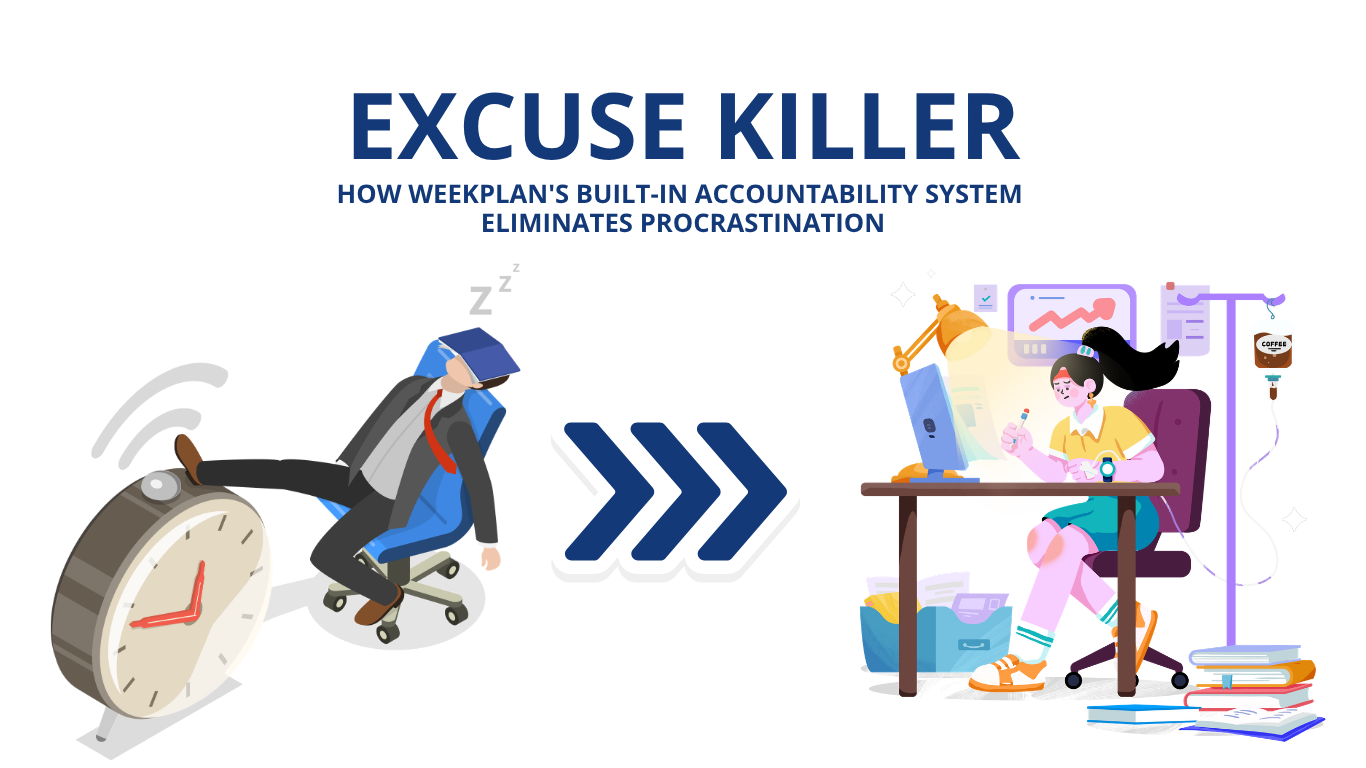
Most productivity systems ignore the excuse problem entirely. Here's how excuse killer productivity works - let's get into it!
Here's what you'll find inside:
- Excuse Killer mechanics - how the accountability feature intercepts procrastination
- Psychology and reframing - patterns behind task avoidance and how to break them
- Seven common excuses - and how the system handles each one
- Setup and tracking - configuring prompts and reading your excuse data
What is the Excuse Killer feature in WeekPlan?
Excuse Killer is a built-in accountability feature that catches procrastination before it becomes a missed deadline. It identifies your specific excuse and prompts you to rethink it - the full WeekPlan features set shows how it fits.
How Excuse Killer works - the mechanism
The system flags when a scheduled task goes untouched. Instead of a notification, it presents a reframing prompt forcing you to articulate why you're avoiding the task. Most excuses collapse once visible.
What happens when you trigger an excuse
When you postpone a task, Excuse Killer prompts you to articulate the reason. Typing out the excuse forces you to see it clearly - and most excuses sound far less convincing once they leave your head. The system then reframes the thought, connecting it back to your weekly goals so you see what's at stake.
How Excuse Killer connects to your weekly goals
Every excuse ties back to a weekly goal. When Excuse Killer shows the same goal postponed three weeks running, the cumulative cost becomes obvious. Skipping one task stops feeling harmless when you see its goal stalling week after week.
The psychology of excuses - why we procrastinate
Procrastination is not a time management problem - it's an emotion regulation problem. People avoid tasks that trigger discomfort: boredom, anxiety, or fear of failure. Be Proactive - Habit 1 in the 7 Habits framework addresses this directly.
What causes task avoidance
Common triggers behind avoidance:
- Unclear scope - the task feels vague
- Fear of judgment - the output will be evaluated
- Perfectionism - imperfect feels worse than unstarted
- Overwhelm - the task is too large to start
Each trigger creates discomfort, and the brain generates an excuse. An anti-procrastination planner makes these patterns visible before months slip away.
The difference between legitimate reasons and excuses
"I'm waiting on data from finance" points to a verifiable blocker - that's a reason. "I don't have time" falls apart when your calendar shows two free hours - that's an excuse. Excuse Killer applies this test automatically.
How small excuses compound into missed goals and lost months
Excuses compound - skip a task Monday, push it to next week, and a month passes with the same goal untouched. Excuse Killer tracks this so each delay has a price.
How Excuse Killer reframes your thinking
When you type "I don't have time," the system responds: "You scheduled 45 minutes for this Tuesday. What changed?" That fact-based question disrupts the vague excuse. Each time you act anyway, excuses lose their authority.
The reframing prompt - how it works
The prompt references your specific context - schedule, goals, past behavior. Writing the reason out makes the excuse feel smaller than it did inside your head.
How cognitive reframing breaks procrastination patterns
"This task is too big" becomes "the first step takes 15 minutes." Over time, the brain generates the reframe on its own - you catch the excuse before the system does.
Why accountability beats willpower
Willpower drains throughout the day - by late afternoon, the brain defaults to avoidance. Accountability works regardless because it runs outside your energy reserves. Excuse Killer provides it by connecting excuses to measurable consequences.
7 common excuses and how Excuse Killer handles each one
Most people cycle through the same few excuses. WeekPlan's Put First Things First framework identifies these patterns.
"I don't have time" - revealing where your time actually goes
Almost always false. Excuse Killer asks you to look at what you actually spent time on. The excuse falls apart when you realize the problem isn't time - it's what you chose to fill it with. Even 20 spare minutes is enough for the first step.
"I'll start Monday" - why delay is the enemy of progress
Monday is the procrastinator's fictional deadline. Nothing changes Monday except the illusion of a fresh start. Excuse Killer prompts you to name what specifically will be different - and when no concrete answer comes, a smaller version starts now.
"It's not the right moment" - how perfectionism masks fear
The right moment doesn't arrive - you create it by starting. Perfectionism dressed as patience is still avoidance. Excuse Killer reframes this by reminding you of past completions - tasks you started at imperfect times and finished anyway. Your own history is harder to argue with than a motivational quote.
"I need more information first" - analysis paralysis
Research mimics work without requiring commitment. Excuse Killer reframes this by prompting the minimum viable next step - not the finished product, just the first concrete action. You rarely need more information than you already have.
"Someone else should do this" - avoiding ownership
Sometimes delegation is the right move - but this excuse is often avoidance wearing a management hat. Excuse Killer prompts a simple choice: delegate it now with a clear handoff, or own it and start.
"I work better under pressure" - the procrastination myth
People who claim this produce lower-quality output and more stress. Excuse Killer reframes this by asking: would starting now make the result worse? The answer is almost always no.
"It's not that important" - misaligned priorities
If it genuinely isn't important, delete it - no guilt required. But most tasks labeled "not important" are actually uncomfortable. Excuse Killer connects every task to your weekly goals, so dismissing one shows which goal takes the hit. That visibility turns a vague shrug into a deliberate choice.
How to set up Excuse Killer for your specific patterns
Setup takes about 15 minutes. Try WeekPlan to start with default prompts and customize as you go.
Steps to configure Excuse Killer:
- Review postponed tasks from the past two weeks
- Identify the pattern - time, fear, or priority excuses
- Set triggers - choose when Excuse Killer activates after a missed task
- Customize prompts - write reframing questions and connect each task to a weekly goal
The stop making excuses habit kicks in within two to three weeks as the system adapts.
From excuses to execution - building the doing habit
The time management matrix shows which tasks matter. Excuse Killer catches the moments you avoid them - together, a productivity habit builder bridging intention and action.
How Excuse Killer trains your brain over time
The first week feels like effort. By week three, reframing feels familiar. By week six, most users catch excuses before the system does.
Tracking your excuse patterns - what the data shows
Patterns you start noticing over time:
- When you avoid - the same time of day or day of week keeps appearing
- What you avoid - creative work, hard conversations, or tasks with unclear scope
- Which excuses repeat - the same three reasons cycling through your weeks
- What breaks the cycle - the reframes that actually get you moving
The weekly review in WeekPlan is where these patterns become visible. Seeing the same excuse three weeks running hits differently than vaguely feeling stuck - that self-knowledge is what separates a real accountability system from a generic overcome procrastination tool.
Stop planning to do - start doing
Excuse Killer targets the real bottleneck - the gap between seeing a task and avoiding it. By connecting excuses to your circle of influence, it keeps the focus on what you can control rather than what feels comfortable. The excuses don't disappear overnight, but they lose their authority once you see them clearly.
Frequently asked questions about Excuse Killer
Is Excuse Killer available on all WeekPlan plans?
Excuse Killer is a built-in feature within WeekPlan's productivity toolkit, designed to work alongside the Eisenhower Matrix and weekly review.
Can you customize Excuse Killer prompts?
Excuse Killer adapts to your patterns - the reframing prompts connect to your specific goals and weekly schedule rather than using generic reminders.
Does Excuse Killer work with team accounts?
WeekPlan supports team accounts, so Excuse Killer works within a shared workspace where each person builds their own accountability habits.
How is Excuse Killer different from a regular reminder?
Reminders tell you a task is overdue. Excuse Killer asks why you're avoiding it and challenges the reasoning with evidence.
How long before Excuse Killer changes my habits?
Most users notice a shift within two weeks. Lasting change takes six to eight weeks.