Digital Planner Vs Paper Planner
Published: June 23, 2026
There are two types of people:
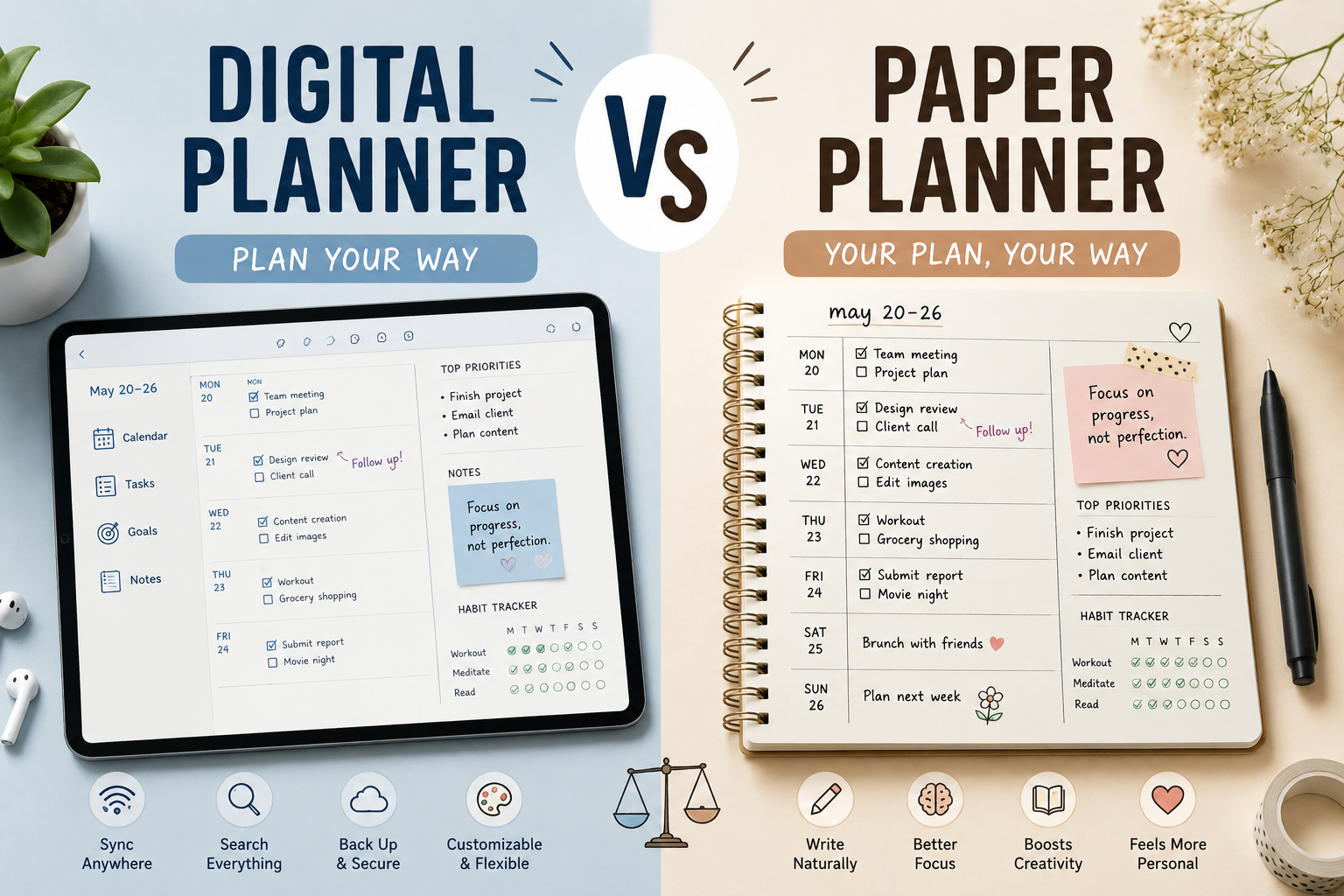
Those who love the feeling of putting pen to paper and crossing tasks off a list. And then there are the ones who can't live without reminders and having their schedule synced across every device they own.
Both groups are trying to do the same thing: stay organized. But when it comes to digital planner vs paper planner, which one actually works better?
Let's break down the pros, cons, and key differences to help you find your perfect planning system.
Digital Planner vs Paper Planner: Definition
A paper planner is exactly what it sounds like: a physical notebook or diary where you write down your tasks and schedules. You open a page, write things down, and physically cross them off when they're done.
A digital planner, on the other hand, is a planning system that lives on a phone or computer. It can be a dedicated planner app or a note-taking tool. Instead of writing everything on paper, you type, tap, drag, and organize your tasks digitally.
Digital Planner vs Paper Planner: Quick Comparison
Both digital and paper planners do the same job. But once you start looking at the details, the differences become clear. From cost and convenience to flexibility, each method has its own strengths and weaknesses.
| Feature | Paper Planner | Digital Planner | Winner |
|---|---|---|---|
| Cost | One-time purchase, no subscriptions | Often free, but premium apps can have recurring fees | Paper Planner |
| Ease of Use | Simple, instant, no setup needed | May require setup and learning | Paper Planner |
| Portability | Must be carried physically | Always available on phone or device | Digital Planner |
| Customization | Limited to pens, stickers, and layouts | Highly flexible with layouts and colors | Digital Planner |
| Focus | No distractions, fully offline | Can be interrupted by notifications | Paper Planner |
| Environmental Impact | Uses paper, physical production required | Uses existing devices, less physical waste | Digital Planner |
| Long-term Storage | Takes physical space, harder to search | Easily searchable and backed up | Digital Planner |
1. Cost
Once you buy a paper planner, that's it. There are no subscriptions, upgrade fees, or premium features locked behind a paywall.
Digital planners can be free, but that's not always the reality. Many charge monthly or annual subscription fees for features like syncing and extra storage.
There's also the cost of the device itself. A digital planner isn't much use without a phone, tablet, or computer.
A paper planner is hard to beat if your goal is simply to organize your life without spending much money.
2. Ease of Use
Nothing is simpler than pen and paper. There’s no setup process or learning curve. You only need to grab a pen and start writing.
Digital planners often offer more features, but that also makes them more complicated. You’ll have to set up calendars, learn shortcuts, or customize layouts before you can use them effectively.
It's not necessarily a bad thing. But if you're looking for the quickest way to get started, paper is the clear winner.
3. Portability
Most people carry their phones everywhere. That means your planner is already in your pocket whether you're at work or waiting in line for coffee.
A paper planner is portable too, but only if you remember to bring it with you. Forget it at home, and you're out of luck.
Digital planners also sync across multiple devices, allowing you to check your schedule from your phone or computer whenever you need it.
4. Customization
Digital planning has a huge advantage if you love making a planner your own. You can change layouts, create custom categories, automate recurring events, add widgets, attach files, and reorganize everything in seconds.
While paper planners also offer some customization, you're ultimately limited by the pages in front of you.
Digital planners give you far more flexibility and allow you to adjust your system whenever your needs change.
5. Focus
Sometimes less technology means more productivity.
There’s only one thing competing for your attention when you’re using a paper planner; the paper itself. There are no notifications, no emails and no social meda alerts.
While digital planners are convenient, they’re often surrounded by distractions.
If staying focused is your biggest challenge, paper provides a cleaner, distraction-free environment.
6. Environmental impact
Digital planners may seem like the greener choice because they don't require paper. But phones and computers require energy to manufacture and charge. Plus, electronic waste creates its own environmental concerns.
Paper planners use natural resources too, but many are made from recyclable materials, and a single planner can last an entire year.
Since most people already own a phone or computer regardless of their planning method, using a digital planner typically doesn't require any additional physical resources.
7. Long-term storage
Need to look up something you wrote three years ago?
Digital planners make that surprisingly easy. A quick search can pull up old appointments, notes, tasks, and events within seconds.
Paper planners can certainly be stored, but they take up physical space. As the years pass, stacks of old planners can become difficult to organize and search through.
Digital planners also offer backups, which means your information can survive a lost phone or computer.
So, Which One Should You Use?
The best planner is the one you'll actually use consistently.
A paper planner is the better choice if you:
- Want a distraction-free planning experience.
- Enjoy journaling, doodling, or taking handwritten notes.
- Prefer keeping things simple without learning new apps.
- Spend long hours away from screens and want a break from technology.
- Like physically crossing tasks off a list.
Choose a digital planner if you:
- Have a busy schedule that changes frequently.
- Need reminders for meetings, deadlines, and appointments.
- Work across multiple devices.
- Travel often and want access to your plans anywhere.
- Manage multiple projects at once.
Week Plan is one option designed to help you manage tasks, set priorities, and stay consistent without overcomplicating things.
Try it out and see if it matches the way you naturally plan your day.