Key points from this guide:
- Executive function gaps - why traditional planners fail ADHD brains and what to look for instead
- Weekly over daily - how a seven-day view reduces pressure and gives room for flexibility
- Role-based planning - organizing life by roles rather than a single to-do list
- Prioritization frameworks - using the Eisenhower Matrix and time blocking with ADHD in mind
- **15-minute setup **- a walkthrough for configuring a system that sticks
Why does ADHD make planning so hard?
ADHD affects executive function - the skills behind organizing thoughts, managing time, and connecting actions to future consequences. When those skills are inconsistent, a reasonable plan falls apart before lunch. That mismatch is why an executive function planner matters more than a generic task list.
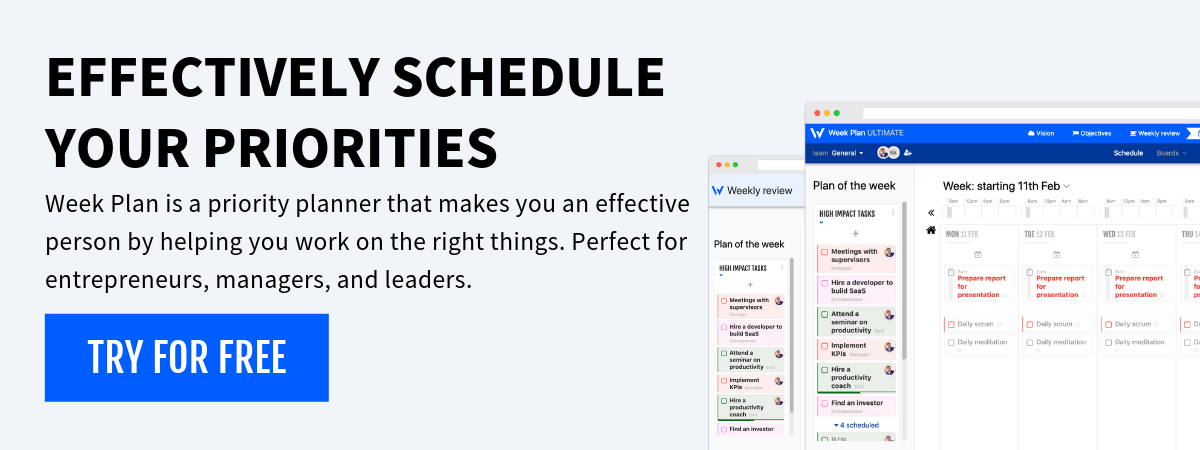
Tools like WeekPlan provide external structure for what ADHD disrupts internally - offloading the organizational work your brain skips. Without that scaffolding, planning becomes a cycle of writing lists, forgetting them, and blaming yourself for the gap.
How Excuse Killer works - the mechanism
Procrastination with ADHD follows a predictable script: see a task, generate a reason to delay, move to something stimulating. The Excuse Killer feature intercepts that loop by asking you to type out the excuse. That labeling breaks the automatic pattern and shifts you toward active decision-making.
What happens when you trigger an excuse
Excuse Killer then reframes the thought. If you wrote "I'll start tomorrow," it surfaces the link to your weekly goal and shows what slips when that task waits. The point is awareness, not guilt - and over time, you start spotting the patterns yourself.
How Excuse Killer connects to your weekly goals
Each excuse ties to a task, and that task ties to a weekly goal. Dismiss something three days running and Excuse Killer shows which goal is slipping. For ADHD brains that struggle connecting present actions to future results, that visible link changes everything.
What does an ADHD-friendly planning system actually need?
A planner built for ADHD cannot rely on willpower or the assumption that you check it at the same time daily. It needs to reduce friction, increase clarity, and provide gentle accountability.
Visual structure over text-heavy lists
Long text-based lists become invisible after a few days. A visual layout - color-coded categories, drag-and-drop quadrants, spatial separation - keeps tasks accessible. That visual clarity is the first thing to look for in any ADHD productivity app.
Flexibility without chaos
Rigid schedules break when something unexpected happens - with ADHD, that is most days. The sweet spot is clear boundaries with movable pieces - you know which tasks matter but rearrange timing as energy shifts.
Built-in prioritization (so you don't have to decide what matters)
Decision fatigue hits harder when executive function is strained. If your planner asks you to rank 20 tasks every morning, you burn out before actual work starts. Built-in frameworks remove that load - place a task in a quadrant and the system handles the rest.
Weekly perspective instead of daily pressure
Daily planners create a pass-or-fail dynamic that almost guarantees ADHD failure. A weekly perspective gives you seven chances instead of one. If Monday was a write-off, Tuesday absorbs the overflow. Pressure drops, guilt drops, and more gets done.
Weekly planning vs daily planning for ADHD - why the week wins
Daily planning assumes consistent routines and stable energy - ADHD rarely provides either. If you woke up foggy or hyperfocused on the wrong project by 10 AM, the day plan is off. Repeat that a few times and most people stop planning altogether.
Weekly planning ADHD-style flips the model - "these five things happen before Friday" rather than today. The weekly planning academy teaches exactly this: plan the week in one sitting, adjust daily based on energy. ADHD time management gets easier when the unit is seven days.
The role-based planning method for ADHD
Most planners organize by project or deadline. Role-based planning organizes by life areas - manager, parent, partner, friend. That distinction prevents the most common ADHD failure: hyperfocusing on one area while everything else falls apart.
Here is how role-based planning works:
- **Define 5-7 roles **- the major areas of life that need regular attention
- Assign 1-3 tasks per role - each role gets a small number of concrete weekly actions
- **Review balance weekly **- if one role has zero tasks two weeks running, something needs attention
- **Adjust without guilt **- some weeks are work-heavy, some family-heavy, and that is fine
The roles feature in WeekPlan was built for this. Create roles once, assign tasks each week, and the system shows where your time goes.
The Eisenhower Matrix for ADHD - prioritizing when everything feels urgent
Urgency and importance feel identical when your brain fires alerts for everything. The Eisenhower Matrix separates the two by placing each task into one of four quadrants. Quadrant 2 - high-impact work with no hard deadline - is the one ADHD brains chronically skip. The real shift in ADHD task management happens when you spend more hours there instead of reacting to Quadrant 1 emergencies.
WeekPlan's Eisenhower Matrix makes sorting physical - drag tasks into quadrants instead of ranking them mentally. That removes the guesswork from prioritization, exactly the bottleneck that stalls ADHD planning. Once tasks sit in their quadrants, choosing what to work on next takes seconds.
Time blocking for ADHD - structure without rigidity
Assigning chunks of your day to specific work sounds simple until time blindness makes every block feel arbitrary. One interruption derails the schedule and the rest of the day collapses. The fix is a looser version built for how ADHD brains actually experience time.
How to time-block with buffer zones
Buffer zones make time blocking survivable for ADHD:
- Add 15-minute gaps - place buffers between blocks for transitions and mental reset
- Use categories, not tasks - block "deep work" or "admin" rather than a specific deliverable
- **Keep mornings flexible - **if energy is unpredictable before noon, block afternoons first
- **Color-code by energy - **high-focus blocks in one color, low-effort in another
**Time blocking **with buffers turns an all-or-nothing system into something that bends with your attention span. The goal is a visible container for your day, not a rigid schedule.
What to do when you blow past your time block
It will happen - you hyperfocus on something interesting and miss the boundary by an hour. Instead of scrapping the day, pick the one task that matters most from whatever time remains and move on.
The weekly review - the habit that makes everything else work
Twenty to thirty minutes once a week - that is all it takes to look back and plan ahead. For ADHD, this creates a recurring checkpoint that catches drifting priorities before they become problems. Without that anchor, even a solid plan quietly goes off course.
A strong weekly review covers:
- What got done - acknowledge completed tasks, even small ones
- What slipped - identify what didn't happen and whether it still matters
- Surprises - unplanned tasks that appeared and how they shifted priorities
- Next week's roles - assign 1-3 tasks per role for the coming seven days
- Energy patterns - note productive vs unproductive days to plan smarter
The weekly review template in WeekPlan walks you through each step, built on the principle of Put First Things First. This single habit does more for ADHD planning than any feature or framework alone.
Common ADHD planning mistakes that make things worse
Some popular productivity advice backfires for ADHD because it was designed for brains that work differently. Strategies built on consistent willpower or rigid habits miss the way ADHD actually operates. Recognizing the traps ahead of time saves weeks of frustration.
Overplanning - why more detail means less action
When planning feels broken, the instinct is adding detail - more subtasks, more categories, more reminders. For ADHD this is a trap. Complexity raises the **activation energy **needed to even open the app, and a system you avoid opening is worse than no system at all.
Switching systems every month
The dopamine hit of a new app is real - fresh interface, clean slate, the fantasy that this time will be different. But constant switching means you never build the muscle memory that makes planning automatic. Commit for **at least eight weeks **and let familiarity become support.
Planning without accountability
A plan nobody sees is easy to ignore.** External accountability** - a weekly review, a shared calendar, a tool that flags missed tasks - is the bridge between intention and action.
How to set up WeekPlan for ADHD in 15 minutes
You can have a working system in 15 minutes and refine it as you learn what your brain needs. The 4 quadrants of time management provide the prioritization backbone.
Follow these steps to get running:
- Create your roles - start with 3-5 life areas needing weekly attention
- **Set one goal per role **- one meaningful outcome per role for the week
- **Sort tasks into quadrants **- drag each into the Eisenhower Matrix
- **Block two focus sessions **- pick two 90-minute windows with buffer time
- **Schedule your review **- choose a day and time, set a recurring reminder
- Start with this week only - do not plan next month, just the next seven days
Setting this up in WeekPlan takes about 15 minutes because the frameworks are built in. The free plan covers everything you need to start.
Planning with ADHD is possible - it just needs the right system
The problem was never your ability to plan - it was the assumption that all brains plan the same way. ADHD needs a system built for inconsistent energy, shifting attention, and the gap between knowing and doing. Weekly planning with roles, prioritization, and regular reviews fills that gap. Once you build around your brain instead of fighting it, planning works.
Frequently asked questions about ADHD and weekly planning
Can a planner really help with ADHD or do I need medication first?
A planner and medication address different parts of the same challenge - medication regulates neurochemistry, while a planner provides external structure ADHD brains need regardless. Many people improve with structured weekly planning alone, and combining both makes treatment more effective.
What is the best planning method for ADHD adults?
Role-based weekly planning combined with the Eisenhower Matrix works well because it reduces decision fatigue and prevents neglecting any life area. The key is visual clarity and built-in prioritization rather than relying on memory.
How often should someone with ADHD review their weekly plan?
A full weekly review once per week - ideally Sunday evening or Monday morning - is the minimum for maintaining direction. A quick two-minute morning scan of your top three tasks keeps the plan active without adding overhead.
Does WeekPlan work with Pomodoro and other ADHD tools?
WeekPlan has a built-in Pomodoro timer connected to your task list, so you start focused sessions without switching apps. It also supports time blocking and recurring task management, pairing naturally with other ADHD strategies.
What if I forget to check my planner?
Forgetting usually means too many steps or the wrong location. Keep your planner open as a browser tab or home screen app, set one daily reminder, and pair the check with an existing habit like morning coffee.