Weekly Review for Productivity: The Science-Backed 5-Step Process
Published: May 12, 2026
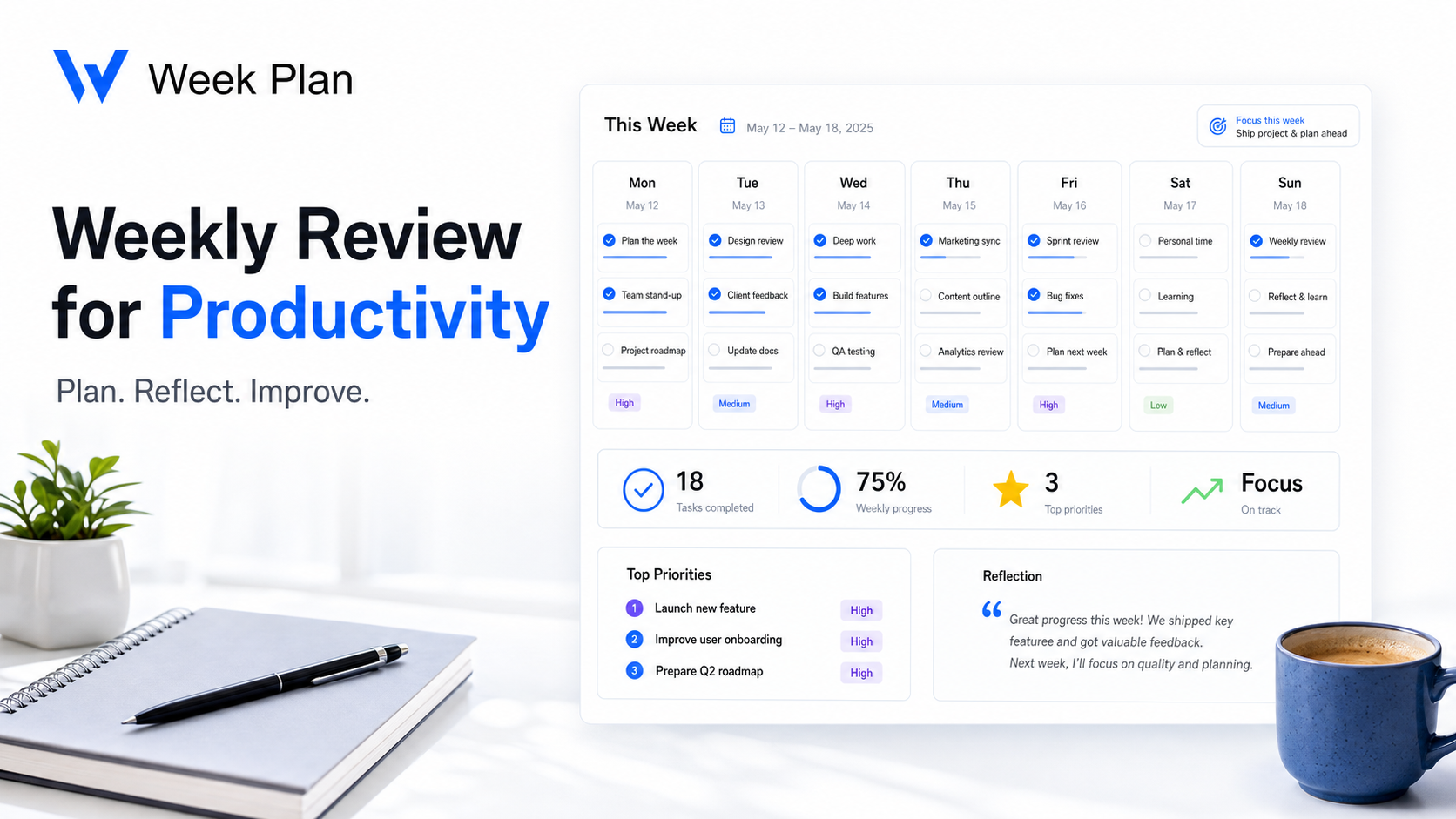
Most productivity advice focuses on what to do during the workday. Plan your morning. Block your calendar. Batch your tasks. But the single habit that separates people who are consistently productive from those who are occasionally productive happens outside the workday entirely.
It is the weekly review.
A weekly review is a structured session, typically 30 to 60 minutes, where you step back from execution, assess what happened over the past seven days and deliberately set up the next seven. It is the practice that connects your daily actions to your longer-term goals and prevents the slow drift that turns busy weeks into unproductive months.
David Allen, creator of the Getting Things Done methodology, calls the weekly review "the master key to your system" and considers it the single most critical habit in his entire framework. But this is not just one author's opinion. Research in cognitive psychology, behavioural science and organisational performance supports the value of regular structured reflection for learning, performance and sustained follow-through.
This article breaks down the science behind why weekly reviews work, gives you a repeatable productivity review process and shows you how to build it into a habit that sticks. If you already run a weekly planning system, this is the missing feedback loop that makes it compound.
What the Research Says About Reflection and Performance
The case for weekly reviews is not built on productivity guru advice. It is built on research across multiple disciplines.
Reflection Directly Improves Performance
A study by Di Stefano, Gino, Pisano and Staats at Harvard Business School tested whether reflecting on work improves subsequent performance. Across multiple experiments, they found that individuals who spent just 15 minutes reflecting on lessons learned performed 23% better on subsequent tasks than those who spent the equivalent time doing additional practice.
The mechanism was self-efficacy. Reflection did not just help people remember what they learned. It made them feel more competent, which increased motivation and follow-through. As Francesca Gino summarised: "When we stop, reflect, and think about learning, we feel a greater sense of self-efficacy. We're more motivated and we perform better afterward."
A weekly review is this reflection principle applied at the weekly cadence. Instead of reflecting on a single task, you reflect on an entire week of work, extracting patterns that no single-day review could reveal. For a deeper dive into why this matters, read our 9 reasons to take time for reflection.
Unfinished Tasks Drain Cognitive Resources
The Zeigarnik effect, first documented by psychologist Bluma Zeigarnik in the 1920s, suggests that incomplete tasks occupy working memory more persistently than completed ones. Your brain treats every open loop, every unresolved commitment and every "I'll get to that later" as an active thread that requires cognitive monitoring.
Masicampo and Baumeister took this further in 2011. Their experiments showed that unfulfilled goals do not just sit quietly in memory. They can interfere with performance on unrelated tasks. Participants with unfinished goals experienced intrusive thoughts, had difficulty concentrating on new activities and performed worse on tasks requiring focus.
Here is the critical part: when participants made specific plans for their unfinished goals, deciding when and how they would complete them, the cognitive interference disappeared. Their performance bounced back to normal. A weekly review is essentially a systematic process for converting every open loop into a concrete plan, which is why it can clear mental fog so effectively.
Weekly Planning Behaviour Reduces Rumination
A 2023 field experiment published in the Journal of Occupational and Organizational Psychology tested the effects of weekly planning behaviour on knowledge workers. The study included 208 participants and 947 weekly diary entries. The findings were practical: weekly planning reduced unfinished tasks, lowered after-work rumination and improved cognitive flexibility.
In other words, people who completed a weekly planning and review session did not just accomplish more. They thought more clearly, adapted to change more easily and reduced work-related rumination during evenings and weekends. The study also found that these benefits were strongest for employees working in unpredictable environments, which is common in modern knowledge work.
The Five-Phase Weekly Review Process
The weekly review is more than "look at what you did and plan what is next." The most effective productivity review process follows a specific sequence designed to first clear your mind, then rebuild your system, then set direction.
This framework synthesises David Allen's GTD weekly review with modern productivity research.
Phase 1: Get Clear
The first phase is about emptying. You are processing every input source so nothing is left floating.
- Clear physical inboxes. Loose papers, sticky notes, receipts and notebooks. Anything captured on paper goes into your system or gets discarded.
- Process digital inboxes. Email, messages, saved links, voice memos and app notifications. For each item, do it if it takes under two minutes, delegate it, schedule it, file it or delete it.
- Empty your head. This is the brain dump. Write down every commitment, thought, worry or idea still occupying mental space. Do not organise. Do not prioritise. Just capture.
The goal of Phase 1 is trust. When every open loop is captured in a system outside your head, the Zeigarnik monitoring stops and your cognitive resources free up for actual thinking.
Phase 2: Get Current
Now you review your existing system to make sure it reflects reality.
- Review your calendar from the past week. Walk through each day. Capture any follow-ups, commitments or action items from meetings you attended. Note anything that was scheduled but did not happen.
- Review your calendar for the upcoming two weeks. Look ahead. Are there deadlines, events or preparation tasks you need to queue up? Flag anything that requires advance work.
- Review your task lists and projects. Go through every active project. Is it still relevant? Does it have a clear next action? Mark completed items. Update stalled ones. If a project has been sitting without a next action for two or more weeks, either reactivate it with a concrete step or move it to a "someday/maybe" list.
- Review your waiting-for list. What are you waiting on from other people? Does anything need a follow-up nudge?
This is where a weekly planner with task and calendar views side by side becomes genuinely useful, because you can see mismatches between what you planned and what actually happened. Todoist's productivity research team frames this as gaining "an accurate assessment of the past week."
Phase 3: Reflect
This is the phase most people skip, and the one the Harvard research strongly supports.
Ask yourself:
- What went well this week? Why?
- What did not go well? What was the root cause?
- What patterns am I noticing across multiple weeks?
- What would I do differently if I could replay this week?
Do not rush this. Even five minutes of genuine reflection activates the self-efficacy mechanism the research identified. You start to see yourself as someone who learns and improves, which directly fuels next week's motivation and performance.
For structured prompts that go deeper, our collection of 12 weekly reflection questions to supercharge your progress is designed specifically for this phase.
Phase 4: Prioritise
Now you decide what actually matters for the coming week.
- Review your goals. Monthly, quarterly and annual. Which ones need attention this week?
- Select 3 to 5 High Impact Tasks. These are the tasks that would make the week a clear success even if nothing else got done. Use the High Impact Tasks framework to separate what is truly important from what is merely loud.
- Assign HITs to specific days. Research on implementation intentions suggests that specifying when you will do something can significantly improve follow-through compared to vague intentions.
The prioritisation phase is what transforms the review from a passive reflection exercise into an active planning tool. Without it, you have done an audit. With it, you have built a roadmap.
Phase 5: Engage
The final phase prepares you for immediate execution.
- Time-block your HITs into your calendar for the coming week. Our time blocking guide covers the mechanics if you are new to this technique.
- Identify your Monday morning task. What is the very first thing you will work on? Having this decided before the week starts eliminates the "what should I do first?" paralysis that wastes most people's Monday mornings.
- Set one weekly intention. Not a task. A way of working. "I will protect my deep work blocks this week." "I will say no to at least two non-essential requests." This primes your decision-making filter for the entire week.
The complete process takes 30 to 60 minutes once you have practised it a few times. The first two or three sessions will take longer because you are processing a backlog. That is normal.
Why Weekly, Not Daily or Monthly
The weekly cadence is not arbitrary. It hits a cognitive sweet spot that other frequencies miss.
Daily reviews are too narrow. You can assess individual tasks, but you cannot see patterns. Was this a productive week overall? Are your projects on track? Are you spending time on the right things? Those questions require a seven-day lens. A daily review answers "what did I do today?" A weekly review answers "am I heading in the right direction?"
Monthly reviews are too infrequent. By the time you notice a problem in a monthly review, you have lost three or four weeks to it. The feedback loop is too slow for course correction. A weekly review catches drift within days.
Weekly reviews also match natural rhythms. Research on the fresh start effect by Dai, Milkman and Riis found that people are more motivated at temporal landmarks such as the start of a new week. The weekly review harnesses this motivational window every seven days.
The ideal setup is a weekly review as the primary feedback loop, supplemented by brief daily check-ins of 5 to 10 minutes and a deeper quarterly review for strategic adjustment. If you are wondering how to balance all three levels, our article on weekly vs daily planning breaks down when each cadence works best.
Building the Weekly Review Habit
Understanding the process is the easy part. Doing it every week for the next 52 weeks is where most people fail. Here is how to make it stick, grounded in habit science.
Anchor It to a Trigger
BJ Fogg's behaviour model shows that habits form most reliably when attached to an existing routine. Choose a specific, consistent trigger:
- "After I finish Sunday lunch, I do my weekly review."
- "Friday at 3pm, I close my laptop and open my review checklist."
- "After I drop the kids at school on Monday, I go to the cafe for 45 minutes."
The trigger must be something you already do reliably. The review becomes the behaviour that follows it. Stephen Covey would call this sharpening the saw, the deliberate practice of stepping back from production to maintain and improve the producer.
Start Smaller Than You Think
If 45 minutes feels like too much, start with 15. Cover only the essentials: brain dump, review last week's wins and losses, and pick your top 3 HITs for next week. A 15-minute review done consistently beats a 60-minute review done sporadically.
As the habit solidifies, gradually add the full five phases. Within a month, the full review will feel natural and the time investment will feel justified by the clarity it produces.
Track Your Consistency
What gets measured gets maintained. Mark each completed weekly review on a calendar, in a habit tracker or inside your planner. Seeing an unbroken chain of completed reviews creates its own motivation to keep going.
Our roundup of best habit tracking apps covers several tools that support weekly habit streaks if you want a dedicated tracker.
Protect the Time
The weekly review is the first thing that gets sacrificed when the week gets busy. That is exactly backwards. The busier the week, the more you need the review to prevent the following week from being equally chaotic.
Block it on your calendar as a recurring event. Treat it as non-negotiable. If Friday afternoon does not work, move it to Sunday evening as part of a broader weekly prep routine. The day matters less than the consistency.
The GTD Weekly Review vs Other Frameworks
David Allen's Getting Things Done methodology popularised the weekly review, but it is not the only framework that uses one. Here is how the major approaches compare:
| Framework | Review Focus | Duration | Key Difference |
|---|---|---|---|
| GTD | System maintenance: inboxes, projects, next actions and waiting-for items | 60 to 90 min | Comprehensive system audit; focuses on trust in your external system |
| 7 Habits | Roles and goals: review each life role and set weekly priorities | 30 to 45 min | Starts from values and roles rather than task lists |
| Agile Results | Outcomes: identify 3 outcomes for the week and reflect on last week's 3 | 15 to 20 min | Deliberately minimal; forces extreme prioritisation |
| 12 Week Year | Execution score: measure percentage of planned actions completed | 20 to 30 min | Quantitative accountability; treats each 12-week block as a "year" |
All four frameworks agree on the core principle: regular structured reflection improves execution. The differences are in scope and emphasis. If you are starting from scratch, the five-phase process in this article blends the best elements of each. If you are already deep in GTD, use Allen's full checklist. If you are values-driven, lean toward Covey's role-based approach.
How Week Plan Supports Your Weekly Review
The five-phase process maps directly onto Week Plan:
| Review Phase | How It Works in Week Plan |
|---|---|
| Get Clear | Inbox/parking lot captures every open loop before scheduling |
| Get Current | Weekly task manager shows completed vs open tasks at a glance |
| Reflect | Journal and notes sections support weekly reflection entries |
| Prioritise | High Impact Tasks markers visually separate priorities from noise |
| Engage | Drag-and-drop week view lets you time-block HITs into specific days |
The review is not about the tool. You can run this on paper, in a spreadsheet or in any task manager. But if you want all five phases, goals, brain dump, reflection, HITs and weekly calendar connected in a single productivity planner, that is what Week Plan was built for.
Try Week Plan free for 14 days — no credit card required.
Frequently Asked Questions
How do you do a weekly review for productivity?
A weekly review for productivity follows five phases: Get Clear, Get Current, Reflect, Prioritise and Engage. First, process all inboxes and do a brain dump. Then review your calendar and task lists from the past week. After that, assess what went well, what did not and why. Finally, select 3 to 5 High Impact Tasks for the coming week, time-block those tasks into your calendar and pre-decide Monday's first action. The entire process takes 30 to 60 minutes and should be done at the same time each week.
What questions should I ask during a weekly review?
Start with these core questions: What did I accomplish this week? What did not get done and why? What patterns am I noticing? What are my top 3 to 5 priorities for next week? What is the single most important thing I can do on Monday?
For a more comprehensive set, see our 12 weekly reflection questions designed specifically for the review process.
How long should a weekly review take?
Plan for 30 to 60 minutes. Beginners typically need closer to 60 minutes as they process a backlog of uncaptured commitments. With practice, most people settle around 30 to 40 minutes. If your review consistently takes longer than an hour, you likely need to tighten your daily capture habits so less accumulates between reviews.
What day is best for a weekly review?
Friday afternoon and Sunday evening are the two most popular options. Friday works well because the week is still fresh in memory and you can close loops before the weekend. Sunday works well because you can combine the review with weekly planning and walk into Monday fully prepared.
Our guide on building a Sunday planning routine covers the Sunday approach in detail.
Is a weekly review the same as weekly planning?
Not quite. A weekly review looks backward, reflecting on what happened. Weekly planning looks forward, deciding what to do next. The most effective approach combines both in a single session: review first, then plan.
Our how to plan your week guide covers the forward-planning side in depth.
Final Thoughts
The weekly review is not a nice-to-have add-on. It is the feedback loop that makes every other productivity practice work. Without it, your plans drift, your tasks pile up and your goals stay abstract. With it, you catch problems within days, learn from every week and compound your results instead of resetting to zero every Monday.
The evidence is useful: even a short period of structured reflection can outperform more practice without reflection. A weekly review gives you that reflection at the cadence where it is most useful: frequent enough to course-correct, spacious enough to see patterns and perfectly timed to ride the fresh-start effect into each new week.