Weekly Planning vs Daily Planning: Which Is More Effective?
Published: May 1, 2026
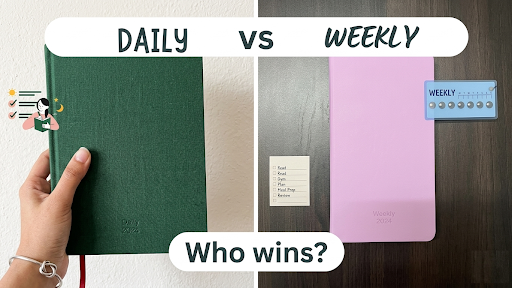 You've probably tried both. You've had stretches where you planned every hour of every day, colour-coding tasks and time-blocking your mornings. It felt productive for a week, maybe two, and then life threw a curveball and the whole system collapsed by Wednesday.
So you swung the other way. You started planning at the weekly level. Big goals, broad strokes, a loose sense of direction. That felt freeing until Friday arrived and you realised half the week's priorities hadn't been touched because nothing was pinned to a specific day or time.
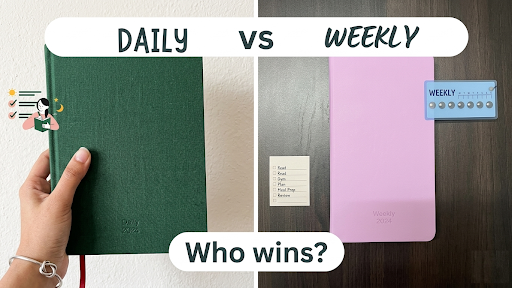
The real question isn't which method is better. It's which method is better for what and whether you should be using both.
This article breaks down weekly vs daily planning side by side. Not opinions. Research, trade-offs and a practical framework you can actually implement, whether you plan on paper, in a spreadsheet or inside a weekly planner.
What Is Daily Planning?
Daily planning is the process of mapping out your tasks, appointments and priorities for a single day, usually the night before or first thing in the morning.
A typical daily planning session takes 10 to 12 minutes. According to Brian Tracy, author of Eat That Frog, that small investment saves roughly two hours of wasted time and effort throughout the day. The reason is simple: when you start the day knowing exactly what to work on, you eliminate the decision-making loop that quietly eats your morning.
Research published in the Journal of Applied Psychology found that daily time management planning (creating task lists, prioritising and deciding when to do what) increases work engagement and performance, particularly on days with fewer interruptions. The study also identified a second type of daily planning called contingent planning, where you anticipate interruptions and plan around them, which held up even on chaotic days.
In practice, daily planning looks like this:
- Review today's calendar and commitments
- Choose your top 1 to 3 tasks for the day
- Time-block those tasks into specific hours
- Batch smaller admin into a single slot
- Do a two-minute end-of-day review
It's granular, immediate and execution-focused. You know exactly what "done" looks like when the day ends.
What Is Weekly Planning?
Weekly planning is a broader process where you review your goals, assess upcoming commitments and decide what matters most across the next seven days before the week begins.
Where daily planning answers "What do I do today?", weekly planning answers "What needs to move forward this week and why?"
A field experiment published in the Journal of Occupational and Organizational Psychology (N = 208 participants, 947 weekly entries) found that a brief weekly planning session at the start of the week reduced unfinished tasks, lowered after-work rumination and improved cognitive flexibility. In other words, people who planned weekly didn't just get more done. They thought more clearly and switched off more easily after work.
A weekly planning system typically includes five steps:
- Reviewing your goals and roles
- Doing a brain dump of everything on your mind
- Identifying 3 to 5 High Impact Tasks for the week
- Blocking those tasks into your calendar
- Running a Friday review to close the loop
The entire session takes 30 to 45 minutes. It's strategic, directional and designed to connect your long-term goals to your short-term actions.
Daily Planner vs Weekly Planner: Side-by-Side Comparison
| Factor | Daily Planning | Weekly Planning |
|---|---|---|
| Time horizon | Today only | Full 7-day view |
| Session length | 10 to 12 minutes | 30 to 45 minutes |
| Focus | Immediate tasks and execution | Goals, priorities and direction |
| Detail level | High (hourly blocks, specific tasks) | Moderate (key outcomes per day) |
| Flexibility | Lower: a disruption can derail the day | Higher: tasks shift between days easily |
| Best for | Packed or unpredictable schedules | Managing multiple projects or roles |
| Stress impact | Reduces daily overwhelm | Prevents long-term scheduling conflicts |
| Risk | Loses sight of the bigger picture | Too vague without daily execution layer |
| Feedback loop | Immediate (end-of-day review) | Weekly (Friday reflection) |
Neither column wins across every row. That's the point. Each method solves a different problem.
When Daily Planning Works Better
Daily planning is the stronger choice when your days are dense, variable or interrupt-heavy.
High-volume task environments. If you manage 15+ tasks per day across different categories (emails, calls, deliverables, admin), daily planning gives you the granularity to sequence and time-block them properly. A weekly plan can't account for that level of detail across five days.
Roles with constant interruptions. The Journal of Applied Psychology study found that contingent planning, where you anticipate disruptions and build buffers, is most effective at the daily level. If you're a manager fielding questions all day or a support lead handling tickets, planning each morning with interruption buffers built in will outperform a broad weekly plan.
Building a planning habit from scratch. If you've never planned consistently, starting with a 10-minute daily habit is far more sustainable than committing to a 45-minute weekly session. The barrier to entry is lower and the feedback is immediate: you planned, you executed, you saw results today.
Days with hard deadlines. When a specific deliverable is due, daily planning forces you to break it into precise steps and assign exact time slots. Weekly planning might tell you "finish the proposal this week" but daily planning tells you "draft Section 2 from 9:00 to 10:30."
When Weekly Planning Works Better
Weekly planning is the stronger choice when you need strategic direction, workload balance or goal alignment.
Multiple projects or roles. If you're juggling a client project, internal reporting, team management and personal goals, weekly planning gives you the altitude to distribute effort across all of them. Without it, the loudest project wins every day and the important-but-quiet work never advances. As noted in Harvard Business Review, professionals who perform weekly planning sessions are 18% more productive and less likely to procrastinate.
Creative or deep work. Deep work needs large, protected blocks. Weekly planning lets you look at your calendar and carve out two or three deep-work windows across the week. Daily planning might try to squeeze them in around meetings, but the weekly view reveals where the real open space is.
Preventing burnout and over-commitment. A daily planner can trick you into overloading every single day because each day looks manageable in isolation. The weekly view exposes the cumulative load. If Monday through Wednesday are packed, you can deliberately lighten Thursday and Friday during your weekly planning session rather than discovering the overload in real time.
Connecting tasks to goals. Weekly planning forces you to ask "Why am I doing this?" before you ask "When am I doing this?" That alignment step is what keeps you working on the right things, not just the next things. A weekly planning system is specifically built to make this connection visible every single week.
The Real Answer: Use Both (The Hybrid Approach)
The daily planner vs weekly planner debate frames this as an either-or choice. In practice, the most effective professionals use both, and the research supports that.
Here's why: weekly planning sets the direction. Daily planning handles the execution. Without weekly planning, your daily plans become reactive lists driven by whoever emails you first. Without daily planning, your weekly plan stays a nice idea that never translates into focused action.
Brian Tracy's data shows that 10 to 12 minutes of daily planning saves two hours of wasted effort. The weekly planning field experiment showed that a planning session at the start of the week improves task completion, reduces rumination and increases mental flexibility. Combine both and you get a system that's both strategically sound and tactically precise.
The hybrid approach works like this:
- Weekly session (Sunday or Monday, 30 to 45 minutes). Review goals. Brain dump. Select 3 to 5 High Impact Tasks. Block them loosely into the week. This is your weekly planning system in action.
- Daily session (each morning or the night before, 10 to 12 minutes). Look at today's slice of the weekly plan. Confirm your top 1 to 3 tasks. Time-block specific hours. Anticipate interruptions and build buffers.
- Friday review (15 to 20 minutes). What got done? What slipped? What do you carry forward? This closes the loop and feeds your next weekly session.
The weekly plan is the map. The daily plan is the turn-by-turn navigation. You need both to arrive somewhere on purpose.
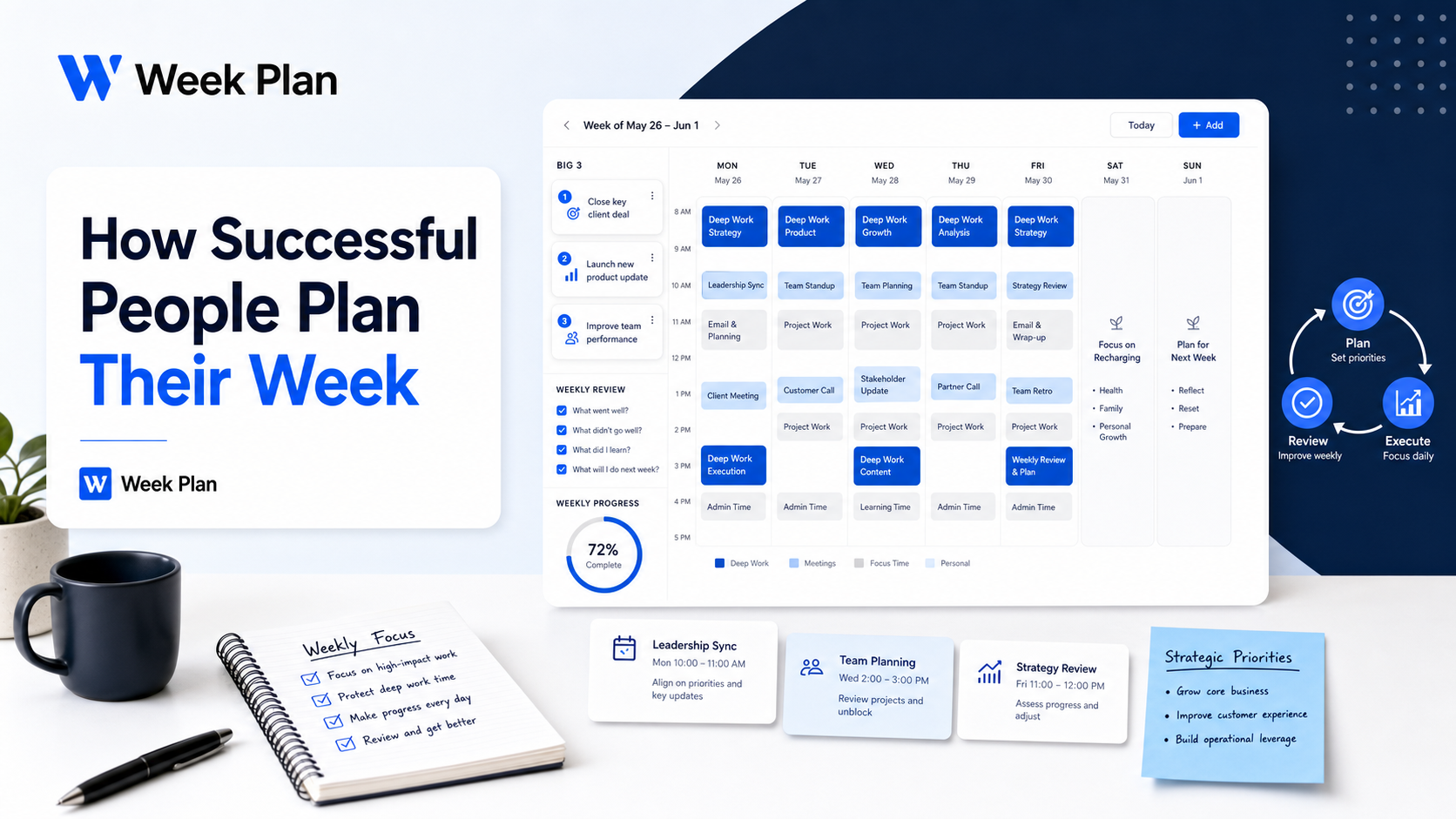
How to Run This System Inside Week Plan
If you want the hybrid approach to live in one place rather than scattered across notebooks, sticky notes and three different apps, here's how it maps to Week Plan:
| System Step | How It Works in Week Plan |
|---|---|
| Weekly goal review | Vision, Roles and Goals structure shows your big picture before you touch tasks |
| Brain dump | Inbox/parking lot captures everything before you schedule it |
| Identify High Impact Tasks | HIT markers visually separate what matters from noise |
| Block the week | The weekly task manager view lets you drag tasks into specific days |
| Daily planning | Each morning, open today's column and refine time blocks |
| Friday review | Completed vs open task filters show exactly what happened |
The tool isn't the point. The system is. You can run this on paper if that's what works for you. But if you want goals, brain dump, HITs, weekly calendar and daily execution all connected in one place, that's what Week Plan was designed for. Try Week Plan free for 14 days - no credit card required.
Frequently Asked Questions
Is it better to plan weekly or daily?
Both serve different purposes and work best together. Weekly planning sets your priorities and direction for the next seven days. Daily planning translates those priorities into specific, time-blocked actions for today. Research shows weekly planning reduces unfinished tasks and rumination, while daily planning can save up to two hours of wasted time per day. The most effective approach is a hybrid: a 30 to 45-minute weekly session paired with a 10 to 12-minute daily session.
What is the difference between a daily planner and a weekly planner?
A daily planner gives you one page or view per day with space for hourly scheduling, detailed task lists and notes. A weekly planner shows all seven days at a glance, focusing on key priorities and broader time allocation rather than hour-by-hour detail. Daily planners suit people with packed, variable schedules. Weekly planners suit people managing multiple projects or roles who need a big-picture view.
Can I use both a daily and weekly planner at the same time?
Yes, and that's the recommended approach. Use your weekly planner to set 3 to 5 high-impact priorities each week, then use your daily planner to break those into specific tasks and time blocks each morning. A tool like the weekly task manager in Week Plan supports both views in one system, so you don't have to maintain two separate tools.
How long should weekly planning take?
A weekly planning session should take 30 to 45 minutes. Any shorter and you're probably not reviewing goals deeply enough. Any longer and the process becomes a chore you'll eventually abandon. If you follow a structured weekly planning system, most people settle around the 30-minute mark after two or three weeks of practice.
What should I include in a daily plan?
Your daily plan should include your top 1 to 3 tasks for the day (pulled from your weekly High Impact Tasks), any fixed appointments or meetings, time blocks for focused work, a batched slot for email and admin, and buffer time for the unexpected. Keep the planning session itself to 10 to 12 minutes.
Weekly planning and daily planning aren't competing methods. They're two layers of the same system. The weekly layer keeps you aligned with what actually matters. The daily layer keeps you focused on what to do right now. Skip the weekly layer and you'll be productive but directionless. Skip the daily layer and you'll be strategic but scattered.
If you want to build both layers into one system, the natural starting point is a proper weekly planning system. Once that's running, adding a 10-minute daily session on top becomes effortless.
And if you want a practical walkthrough of exactly how to plan your week step by step, read how to plan your week next.